Readers find authors in a dozen places: a retailer listing, a podcast, a festival programme, a friend’s recommendation. Almost all of them end the same way, with a search for your name. What they find at that moment decides whether they buy the next book or forget about you by Friday.
An author website is the one part of that journey you own outright. Retailers change their algorithms, social platforms change their rules and publishers change their priorities. Your site, and the mailing list behind it, stay put. Here is what it needs.
Your mailing list comes first
If an author website only did one thing well, it should be turning visitors into subscribers. Readers who find you on Amazon belong to Amazon. Readers on your mailing list belong to you, and they are the people who buy on launch day, leave the early reviews and tell their friends.
That means:
- A sign-up form on every page, not just one buried in the footer
- A reason to join, such as a free short story, a bonus chapter or early access to new releases
- A short welcome sequence, so new subscribers know who you are before your next launch email lands
Our email marketing page covers how we set this up for clients.
A page for every book
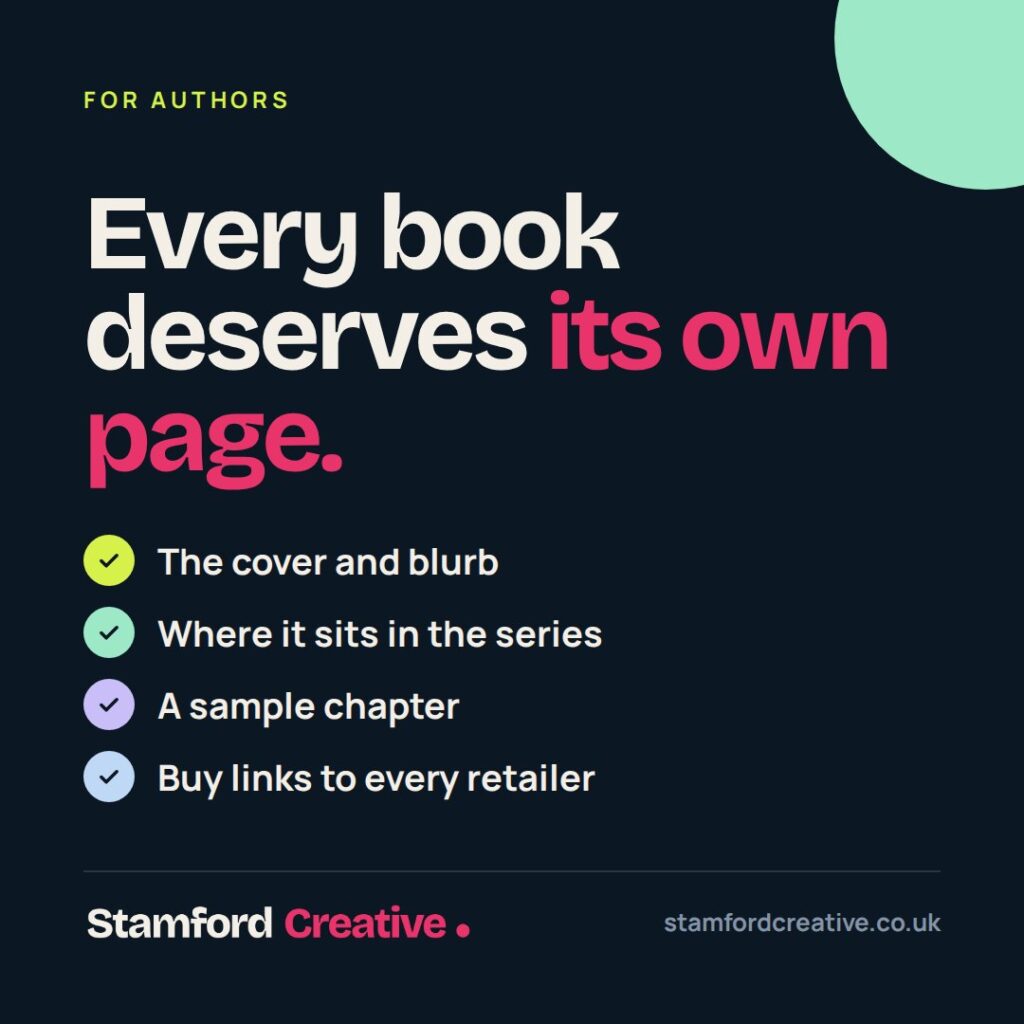
A single “Books” page with a row of covers is a start, but every book deserves its own page. Each one should have:
- The cover and a proper blurb
- Where it sits in the series, with links to the books either side
- A sample chapter or an extract
- Buy links to every retailer, not just one
Individual book pages are how readers find a book by its title in Google, and they are where one sale quietly turns into the next.
A press and events kit
Festival organisers, podcast hosts and journalists all want the same things: a short biography, a longer one, a good author photo, cover images and a way to get in touch. Put them on one page and they will take what they need without emailing you, which makes you much easier to book.
Found by your name and your titles
Search for your own name and each of your book titles. If your website is not the first result, or not on the first page at all, it is usually fixable: proper page titles, a clear structure and book markup that tells search engines exactly what each page is about. The same groundwork helps AI tools describe you and your books correctly when readers ask them. There is more on that on our AI search page.
A look that belongs to your books
A generic author template can make a thriller writer and a cosy crime author look identical. Your site should feel like part of the books, with colours, type and imagery that fit your genre and your covers. And if your author photo is a cropped holiday snap, it is worth replacing. A good portrait does more for a biography page than any amount of copy.
Selling direct, if you want to
Signed copies, bundles and ebooks can all be sold from your own site, alongside the retailers rather than instead of them. It is not for everyone, but it can be a useful extra for authors with a loyal readership.
Easy to update between books
Finally, the site has to be something you can update yourself. Adding a new book, a pre-order link or an event date should take minutes, not a call to a developer. If updating your website feels like a chore, it will not get done.
We build author websites, set up newsletters and handle branding and author photography, all in-house. Websites start from £350, with ecommerce for direct sales from £1,000. See how we work with authors, or tell us about your books.